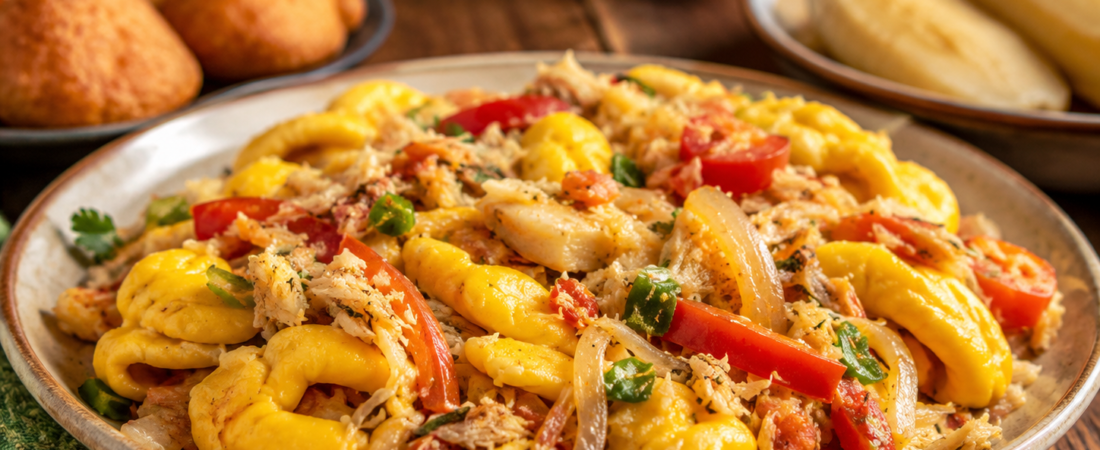
It is Jamaica’s national dish, the one people talk about with pride, the one that shows up on breakfast plates, Sunday tables, hotel menus, and family gatherings. sad to say, as a Jamaican child, I didn’t like ackee.
For years, something about it just never clicked with me. Maybe it was fear. Growing up, I was always told ackee could be poisonous if it wasn’t properly ripened, and as a child, that alone was enough to make me suspicious of it. Or maybe it was the texture — soft and delicate in a way I didn’t understand back then. Whatever the reason, ackee and I just didn’t get along.
It wasn’t until my early twenties that I finally started eating it. Funny enough, now I believe ackee is one of those foods that comes with an acquired taste. The interesting thing is, ackee itself is almost tasteless. It absorbs and carries the flavor of whatever it’s paired with, which is probably why it works so perfectly with something salty and bold like saltfish.
And together, those two ingredients become something bigger than food — they become Jamaica’s national dish.
A Dish That Represents Jamaica
I remember seeing a report saying ackee and saltfish ranked as one of the best national dishes in the world — somewhere around number two according to National Geographic. Honestly, I wasn’t surprised.
Because once you truly understand the dish, you understand why Jamaicans hold it so close.
Ackee and saltfish is balance.
Softness and saltiness.
Creamy and savory.
Simple ingredients creating something unforgettable.
Growing up, I mostly saw ackee cooked with corned pork in my parents’ kitchen. Later in life, I discovered ackee and bacon — which I absolutely love, by the way. But no matter how many versions I try, ackee and saltfish remains the best combination. They complement each other perfectly.
If I had to describe cooked ackee to someone who has never seen it before, I’d say it looks a lot like scrambled eggs. That comparison confuses people even more when they learn it’s actually a fruit.
And somehow, that feels very Jamaican too — unexpected, flavorful, and impossible to explain properly unless you’ve lived it.
Now I understand why so many Jamaicans love it. Ackee and saltfish is not just food on a plate. It is culture, memory, patience, and pride. It is one of those dishes that reminds you that sometimes the foods you avoid as a child become the foods you appreciate most as an adult.
Now that you know why I had to grow into this dish, let me show you how I make it at my island table.
Jamaican Ackee & Saltfish Recipe
Yield
Serves 4
Prep Time
20 minutes
Cook Time
25 minutes
Total Time
45 minutes
Ingredients
- 1 can ackee, drained carefully
- ½ lb salted codfish/saltfish
- 2 tablespoons cooking oil
- 1 medium onion, sliced
- 2 stalks scallion, chopped
- 2 cloves garlic, minced
- 1 small tomato, chopped
- ½ sweet pepper, sliced
- 1 Scotch bonnet pepper, whole or thinly sliced, adjust to taste
- 1 teaspoon fresh thyme leaves, or 2 sprigs fresh thyme
- ½ teaspoon black pepper
- ½ teaspoon paprika, optional
- ½ teaspoon all-purpose seasoning, optional
- 1 tablespoon butter, optional
- Salt, only if needed
Important Ackee Note
If you are using fresh ackee, only use ackee that has opened naturally on the tree. Never force ackee open. For ease and safety, canned ackee is the best option for most home cooks, especially if you are outside of Jamaica.
Ackee is delicate, so handle it gently. If you stir it too much, it can break apart and become mushy.
Preparing the Saltfish
- Rinse the saltfish under cool water to remove some of the surface salt.
- Place the saltfish in a pot and cover it with fresh water.
- Boil for 10 to 15 minutes.
- Drain the water, taste a small piece, and if it is still too salty, boil it again in fresh water for another 5 to 10 minutes.
- Once the saltfish is at the right salt level, drain it and let it cool slightly.
- Use your fingers or a fork to flake the saltfish into small pieces. Remove any bones and skin if necessary.
Cooking the Ackee & Saltfish
- Heat the cooking oil in a large skillet or Dutch pot over medium heat.
- Add the onion, scallion, garlic, sweet pepper, tomato, thyme, and Scotch bonnet pepper.
- Sauté for 3 to 5 minutes until the vegetables soften and become fragrant.
- Add the flaked saltfish to the pot.
- Stir well and allow the saltfish to cook with the seasonings for about 5 minutes.
- Add black pepper, paprika, and all-purpose seasoning if using.
- Gently add the drained ackee to the pot.
- Use a spoon to carefully fold the ackee into the saltfish and seasonings. Do not stir too hard.
- Let everything cook together for 5 to 7 minutes on low heat.
- Add butter at the end if you want a richer finish.
- Taste and adjust seasoning only if needed. Be careful with extra salt because the saltfish already has salt.
- Remove from the heat and serve warm.
What to Serve with Ackee & Saltfish
Ackee and saltfish can be served in many ways, but these are some of the best pairings:
- Fried dumplings
- Boiled green banana
- Boiled yam
- Boiled dumplings
- Roasted breadfruit
- Fried breadfruit
- Festival
- White rice
- Fried plantain
- Hard dough bread
For breakfast, I love it with fried dumplings, boiled green banana, or breadfruit. For a heavier meal, white rice or ground provisions work beautifully.
What’s on My Table
When ackee and saltfish is on my table, I want it served warm, colorful, and full of flavor.
My plate would have:
- Ackee and saltfish cooked with onion, scallion, thyme, sweet pepper, and Scotch bonnet
- Fried dumplings or boiled green banana
- A few slices of fried plantain
- A warm cup of cocoa tea on the side
That is the kind of breakfast that makes you slow down and enjoy the morning.
My Tips for the Best Ackee & Saltfish
- Do not overcook the ackee. Add it near the end.
- Fold the ackee gently instead of stirring hard.
- Boil the saltfish first so the dish does not become too salty.
- Keep the Scotch bonnet whole if you want flavor without too much heat.
- Slice the Scotch bonnet if you want the dish spicy.
- Use fresh thyme if you can.
- Let the saltfish cook with the seasonings before adding the ackee so the flavor builds properly.
- Do not overcrowd the pot. Ackee needs space so it does not mash out.
A Little Reflection
Ackee and saltfish taught me that some foods take time. As a child, I judged it by what I heard and what I saw. I thought about the warnings, the texture, and the way it looked on the plate. I did not understand why people loved it so much.
But growing up changes the way you taste things. The same dish I once avoided became one I learned to appreciate. Now, when I see ackee and saltfish on a plate, I see more than Jamaica’s national dish. I see patience. I see tradition. I see the kind of food that carries history without needing to explain itself.
That is the beauty of Jamaican food. Sometimes it does not beg you to understand it right away. It waits for you. And when you are ready, it welcomes you back to the table.
Next at My Table
If you enjoyed this story, pull up another chair and continue with Jerk Chicken, the smoky, spicy street food that can make your eyes water and still have you going back for more.
From My Island Table to Yours—may the spice linger, the stories inspire, until another story, another bite.